_edited_.png)
Q & A: CGT EXEMPTION
- Sep 23, 2025
- 2 min read
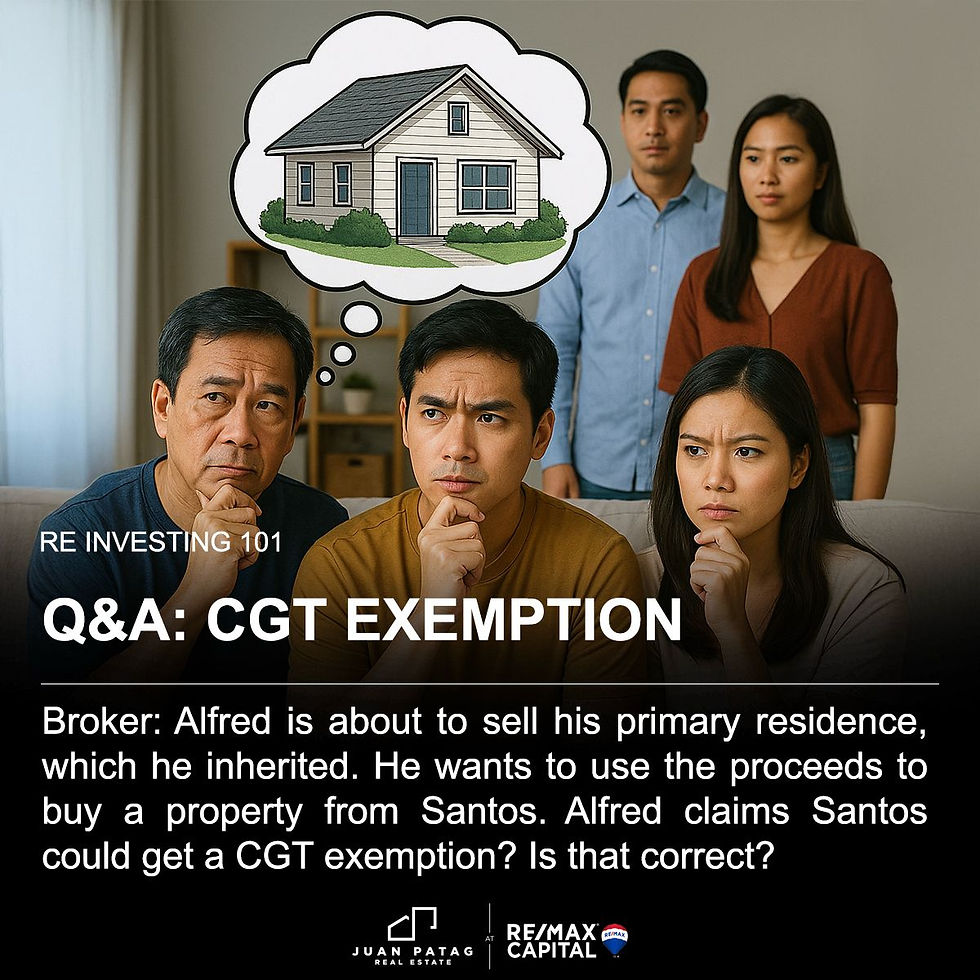
Broker:
We’re trying to close a deal. Buyer (let’s call him Alfred) is about to sell his primary residence (Property A), which he inherited. He wants to use the proceeds to buy a property from Santos (Property B). Alfred claims Santos could get a CGT exemption since he’s selling his primary home. Is that correct?
JPRE:
No. The exemption applies to Alfred, not Santos. Alfred can claim CGT exemption on the sale of Property A, which benefits him directly. That exemption doesn’t transfer to Santos.
Where it could matter is in pricing: Alfred may factor the savings from his CGT exemption into his offer for Santos’s property. That’s the only way Santos benefits indirectly.
Important: Alfred must still deposit the supposed CGT amount into an escrow account before the documents are submitted to the BIR. Also, the escrow agent will only release the CGT amount to Alfred after the completion of his purchase.
Out of curiosity—was Alfred the only heir/owner?
Broker:
No, he has siblings, Bob and Carla.
JPRE:
And only Alfred is buying from Santos? Meaning, after transfer, Property B will be solely under Alfred’s name? Are Bob and Carla planning to purchase properties of their own?
Broker:
Yes, only Alfred is buying Property B. I don’t know about the others.
JPRE:
Then here’s the catch: only Alfred can claim CGT exemption for his one-third share of Property A—assuming Bob and Carla don’t buy any properties. Bob and Carla’s two-thirds share will be subject to CGT.
Broker:
Wait, are you sure?
JPRE:
Yes. Look at Schedule 3 of BIR Form 1706. There’s a section for “Unutilized Portion.”
Since Bob and Carla aren’t reinvesting their shares into Property B—or another principal residence—their exemptions are treated as “unutilized.” So Alfred’s one-third share can go to escrow, but the other two-thirds must be paid directly to the BIR.
But if Bob and Carla decide to buy properties, they can separately avail of the CGT exemption on their own shares, provided they reinvest into new principal residences. But they must be sure before submitting documents of Property A to the BIR. Otherwise, their shares will be taxed and penalized for non-payment.